
In any setting where people move fast around equipment, doors, and each other, breakaway lanyards are not a nice-to-have — they are a safety spec. Breakaway lanyards use a plastic connector that separates under a sharp tug, so a caught credential releases instead of choking or dragging the wearer. For schools and hospitals ordering ID lanyards in volume, this one feature should be non-negotiable.
This guide explains how breakaway lanyards work, where they matter most, and how to spec custom credentials that stay safe without giving up durability or branding.
A breakaway lanyard has a small buckle at the back of the neck designed to pop apart under roughly a few pounds of pull. If a student’s lanyard snags on a bus rail or a nurse’s badge catches on a bed rail or machine, the connector releases and the lanyard falls away. It reconnects in a second, so the safety benefit costs nothing in daily convenience.
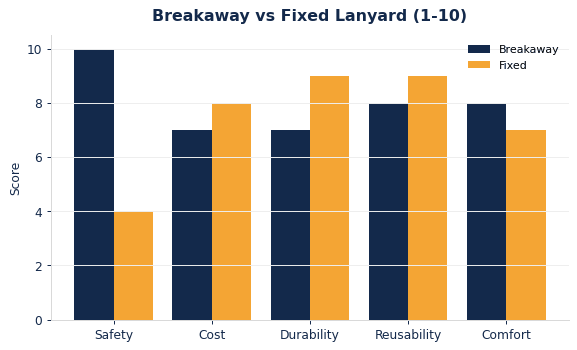
Fixed lanyards, by contrast, are a continuous loop with no release point. They are cheaper and marginally more durable, which is why they still appear at trade shows — but in a school or clinical environment they create an entanglement risk that safety officers rightly flag. The chart compares the two across the factors buyers weigh.
Standard breakaway lanyards release at the back of the neck. Dual-breakaway designs add a second release at the badge attachment, so the credential can detach on its own if grabbed. Hospitals handling agitated patients and schools worried about horseplay often prefer dual-breakaway for the extra margin.
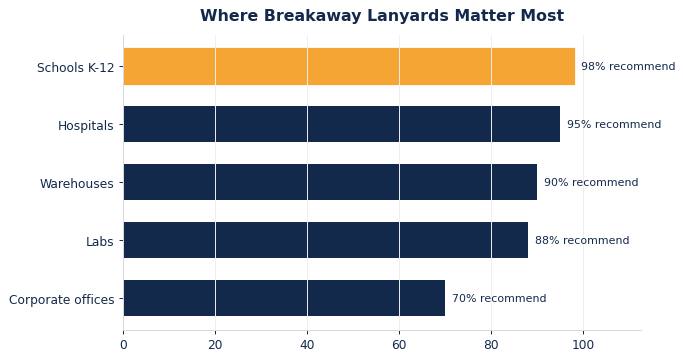
Any environment with moving equipment, doors, or crowds benefits, but a few settings make breakaway lanyards essential. K-12 schools face bus rails, playground equipment, and roughhousing. Hospitals and clinics have bed rails, IV poles, and the need to break free quickly. Warehouses and labs add machinery and moving carts.
Corporate offices carry lower risk, but many still standardize on breakaway lanyards for consistency and to cover occasional plant tours or events. The chart below shows how strongly each setting calls for the feature.
You do not trade branding for safety. A breakaway lanyard prints exactly like a fixed one — screen print for one or two colors, or dye-sublimation for full-color, edge-to-edge art. Choose width by use: 3/8 inch for light office use, 5/8 or 3/4 inch for schools and hospitals that want a bigger logo area and a sturdier feel.
| Setting | Recommended lanyard | Attachment |
|---|---|---|
| K-12 schools | 5/8″ breakaway, dual optional | Swivel hook + reinforced tab |
| Hospitals | 3/4″ dual-breakaway | Badge reel or bulldog clip |
| Warehouses/labs | 5/8″ breakaway, high-vis color | Swivel hook |
Match the attachment to how the badge is used — a retractable reel for staff who swipe often, a bulldog clip for simple display. Compare attachment styles in our companion Eco-Friendly Lanyards: rPET & Bamboo Options for Green Events, and see materials and print options across our custom credentials & lanyards range.
For a district or hospital system, the challenge is consistency across hundreds or thousands of staff. Standardize on one or two breakaway lanyard specs — a width, a color scheme, and an attachment — so replacements always match and procurement is simple. Color-coding by role (staff, contractor, visitor, or department) turns the lanyard into an at-a-glance access signal, which is a security benefit on top of the safety one.
Build the safety into the default, not the exception. Order every lanyard pre-assembled with the breakaway buckle engaged, and write the requirement into your credential policy so no one orders fixed lanyards to save a few cents on a side purchase. A short line in onboarding — explaining why the buckle is there and asking staff not to tape or tie around it — keeps the feature working as intended.
Plan the reorder cadence around real wear. Lanyards worn daily fray at the clip and fade at the fold within a year or two, so budget an annual or biennial refresh rather than replacing them one-off as they fail. Ordering the refresh in a single batch keeps the whole organization on the same current spec and color, which matters when a security team needs to trust that a credential looks the way it should.
A dual-breakaway lanyard loses its second safety point if the badge is fixed to a non-releasing holder. Pair it with a reel or a holder designed to detach so the credential truly frees itself when grabbed.
The hardware at the bottom of a breakaway lanyard matters as much as the buckle at the top, because it decides how staff actually use the credential. A swivel hook is the versatile default, letting a badge rotate to face forward. A bulldog or alligator clip grips thicker cards and multi-badge stacks. For anyone who swipes constantly — a nurse at every door, a warehouse worker at every scanner — a retractable reel saves the daily fumble and reduces the yanking that wears a lanyard out.
Match the attachment to the failure you most want to avoid. Reels are wonderful for frequent swiping but add a cord that can itself snag, so in the highest-risk clinical settings a dual-breakaway lanyard with a detaching badge holder is safer than a fixed reel. In schools, a simple swivel hook with a reinforced tab is durable and cheap, and it keeps the assembly light enough that the breakaway buckle releases exactly as designed under a child’s tug.
Think about the badge itself, too. A rigid holder protects a printed card and keeps it readable, while a flexible sleeve is cheaper for short-term events. Whatever you choose, confirm the whole assembly — lanyard, attachment, and holder — releases as a system, because a breakaway strap paired with an unbreakable clip and a fixed badge only solves part of the safety problem you set out to address.
For a safe, consistent credential program, decide four things up front: the lanyard width, the breakaway type (single or dual), the attachment, and the color-coding by role. Order everything pre-assembled with the buckle engaged, write the breakaway requirement into policy so no one substitutes a fixed lanyard, and plan a scheduled refresh rather than one-off replacements. Handled this way, breakaway lanyards protect wearers without adding daily friction, and a security team can trust that every credential in the building looks and behaves the way it should.
Many districts and safety policies require them, and even where they aren’t mandated they are strongly recommended. Because the cost difference is minimal, breakaway is the safe default for any K-12 order.
No. The buckle only releases under a deliberate tug; normal wear feels the same as a fixed lanyard. A wider 5/8 or 3/4 inch strap gives a substantial, quality feel.
Tell us your setting and volume and we’ll spec breakaway lanyards, attachments, and print that fit.