
Every event organizer eventually faces the same decision at the credential stage: should access passes be laminated, printed on plastic cards, or run as economical paper passes? The three formats look similar hanging from a lanyard, but they behave very differently in the field. A laminate that survives a three-day music festival in the rain is overkill for a one-morning breakfast seminar, and a paper pass that works fine indoors will curl and tear the moment it meets a lanyard clip and a sweaty August afternoon. This guide walks through when a laminate credential earns its place and when a lighter format does the job for less.
A laminate is not just a printed card in a plastic sleeve. In the credential world it usually means artwork printed on a synthetic stock and then sealed inside a laminate pouch, producing a single rigid, waterproof pass. The most common printable core is Teslin, a synthetic paper that comes in 10 mil and 14 mil thicknesses, with 10 mil being the standard choice for most passes and 14 mil reserved for when you want extra stiffness. Teslin is waterproof, puncture and tear resistant, and prints on inkjet, laser, and offset presses. Its most useful trait for credentials is bonding: lamination peel strength on Teslin runs roughly two to six times that of coated papers, so the pouch will not delaminate at the edges the way a laminated sheet of regular cardstock does.
Once the printed core is sealed, the finished laminate is typically a few millimeters thick because the pouch adds material on both faces. Pouch films are commonly in the 5 to 10 mil range per side, though the exact figure varies by supplier; treat that as an indicative range rather than a fixed spec. The result is a pass you can drop, soak, and yank on for a week without it failing.
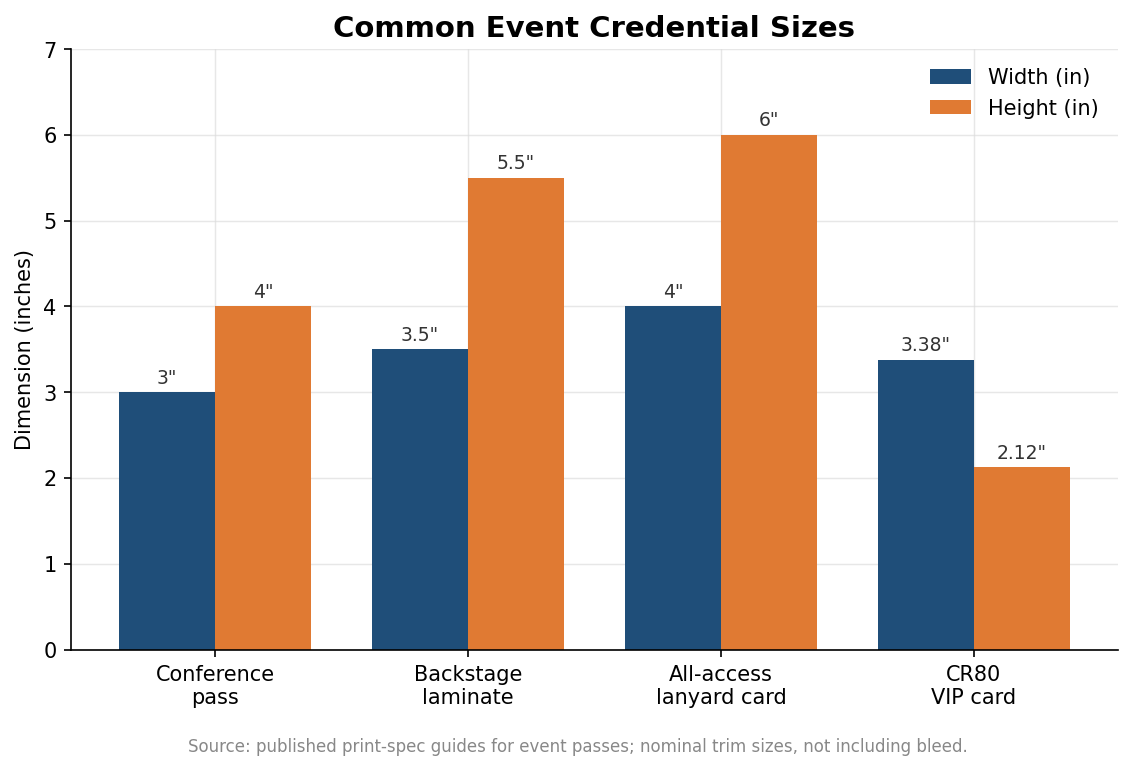
Credential formats have settled into a handful of recognizable sizes, and choosing among them is mostly about how much information and artwork the pass has to carry. A conference pass is commonly 3 by 4 inches, a laminated backstage pass around 3.5 by 5.5 inches, and a large all-access lanyard credential 4 by 6 inches. When you want a reusable, wallet-style pass, the CR80 card at 3.375 by 2.125 inches is the same footprint as a credit card and works in badge holders and reels. The chart below shows how these compare.
Reserve room at the top. Whatever size you pick, leave roughly half an inch of clear space at the top edge for the lanyard punch or slot so the hole does not land on a name, logo, or barcode. Set your artwork at 300 DPI in CMYK, add a 0.125 inch (3 mm) bleed on all outer edges, and keep critical text and logos at least 0.125 to 0.25 inch inside the trim line. If the pass carries a QR code or barcode for scanning, print it dark on a light background inside its own quiet zone so handheld readers lock on quickly.
The case for a laminate comes down to duration, environment, and reuse. Multi-day and outdoor events are the clearest fit: festivals, tours, sporting events, and construction or site credentials all subject a pass to rain, sweat, and constant handling, and a sealed Teslin laminate shrugs that off where paper would not last the first afternoon. Security-sensitive access is the second driver. Because a laminate is difficult to peel apart without destroying it, and because holographic overlays and custom foil can be added, laminates are the standard for backstage, all-access, and restricted zones where a forged or swapped pass is a real risk.
The third case is a pass people keep. Season credentials, crew laminates, and annual membership passes are worn dozens of times, and the cost of a durable laminate is easy to justify when it replaces a stack of disposable passes. If your event is a single indoor day, none of these pressures apply, and a lighter format is the smarter spend.
A CR80 plastic card makes sense when the credential needs to slot into an existing access system, a badge reel, or a wallet, and when you want a clean, uniform look across staff. It is reusable and rigid, but its small size limits how much artwork and access information you can print, so it suits ID-style badges more than large all-access art. Paper and light cardstock passes, meanwhile, are the economical choice for high-volume, short-duration use. Indicative market pricing shows just how wide the spread is: simple paper event passes can run around 13 cents each, while premium RFID-enabled badges reach well over a dollar apiece, with laminates sitting in between. Those figures are illustrative ranges from published event-printer catalogs, not a quote, and your real number will move with quantity, finish, and any security features. The rule of thumb holds regardless: match durability to how long the pass has to survive, and do not pay for a week of resilience on a pass that gets thrown away at lunch.
Laminates take longer to produce than a flat printed sheet because of the sealing and finishing steps, so the calendar matters as much as the spec. Event-credential printers generally publish tiered production windows, and the difference between them is real money. The chart below shows a common tier structure, from a standard run of about 20 business days down to an express turnaround of roughly 3 days.
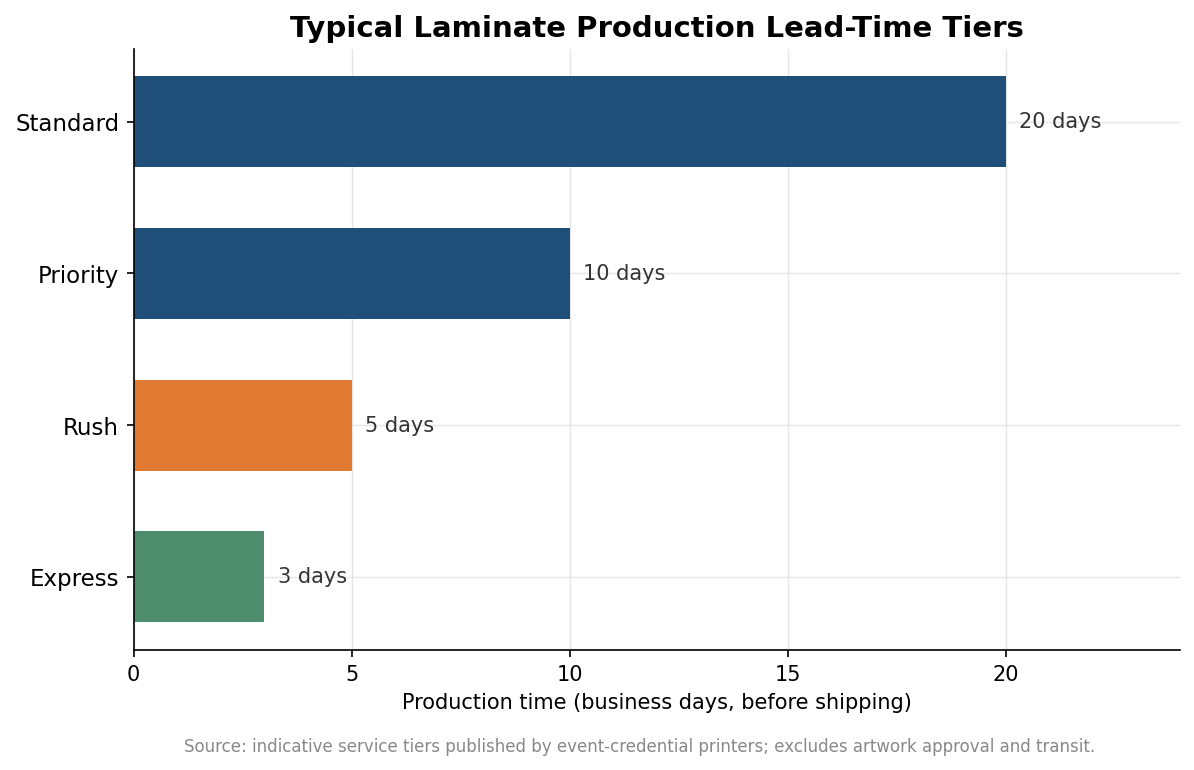
Two things routinely blow up these timelines, and neither is the printer’s fault. The first is artwork approval: the production clock usually starts after you sign off on a proof, not when you place the order, so a slow internal approval can quietly add a week. The second is transit, which sits on top of production and is easy to forget when the event date feels far away. The safe approach is to lock artwork early, build in a proof-review buffer, and treat the express tiers as insurance rather than the plan. Specify the format that matches your event’s length and access needs, get the punch and bleed right the first time, and the credential stops being a last-minute scramble and becomes the one part of the show that just works.