The imprint method you pick for a custom lanyard shapes more than how the logo looks. It sets how many colors you can use, whether fine artwork survives, how the band wears over a multi-day event, and—often overlooked—your minimum order and lead time. Three methods cover the vast majority of custom lanyards: screen printing, dye sublimation, and weaving. Each puts your mark on the webbing in a fundamentally different way, and that difference is what should drive your choice.
Screen printing pushes ink through a fine mesh stencil onto the surface of the woven polyester, then cures it with heat. It is the most common and generally the least expensive option, and it excels at simple, solid logos. Because each color needs its own screen and setup, it is built for one to three spot colors rather than complex art.
Dye sublimation works from the inside out. Your artwork is printed onto a transfer, then heat and pressure turn the dye into a gas that bonds into the polyester fibers themselves. The color becomes part of the strap rather than a layer sitting on top, which is why sublimation handles full-color, edge-to-edge designs that the other methods cannot. It requires man-made fabric, so it is a polyester process.
Woven lanyards skip ink entirely. The design is created in the weave using colored threads, the same way a clothing label carries a logo. Nothing can rub off because there is no surface print, which gives woven bands the best abrasion resistance of the three and a textured, premium feel.
This is where the methods separate most clearly. Screen printing is limited to spot colors, typically one to three, and it is not suited to gradients, drop shadows, or photographic designs. If your logo is a clean two-color mark, it will look crisp and cost less; if it has a soft gradient, screen printing will flatten it.
Dye sublimation is the full-color option. It reproduces gradients, background patterns, fine lines, and edge-to-edge coverage with no per-color setup charge, so a ten-color festival design costs the same to print as a two-color one. That makes it the default for event and expo branding where the whole strap is part of the artwork.
Woven sits in between on color and behind on detail. You are limited to the yarn colors loaded into the loom, and very small text or thin lines can lose crispness because the smallest unit is a thread rather than a printed dot. What you gain is durability and a tactile, high-end look that reads as premium in the hand. One more practical note: printing both sides is effortless and cost-neutral with dye sublimation, while screen printing a second side means a second set of screens and setup.
Lanyard webbing comes in a handful of standard widths, and the width you choose directly limits how much artwork will fit and stay legible. The common sizes are roughly 3/8 inch (about 10 mm), 1/2 inch (about 12–13 mm), 5/8 inch (about 16 mm), 3/4 inch (about 20 mm), and 1 inch (about 25 mm). The 3/4-inch and 1-inch widths are the workhorses for printed lanyards because they give a printer enough room for a logo plus readable text. The narrower widths look sleek but leave little space, so reserve them for a short word mark rather than a detailed design. Standard finished length is around 36 inches of strap, which sits as roughly an 18-inch loop when worn; treat these figures as typical rather than exact, since shops cut to their own house standards.
If you are set on a full-bleed, photographic look, pair that intent with a wider strap and dye sublimation so the art has room to breathe. A busy design crammed onto a 3/8-inch band will read as a smudge from more than a few feet away.
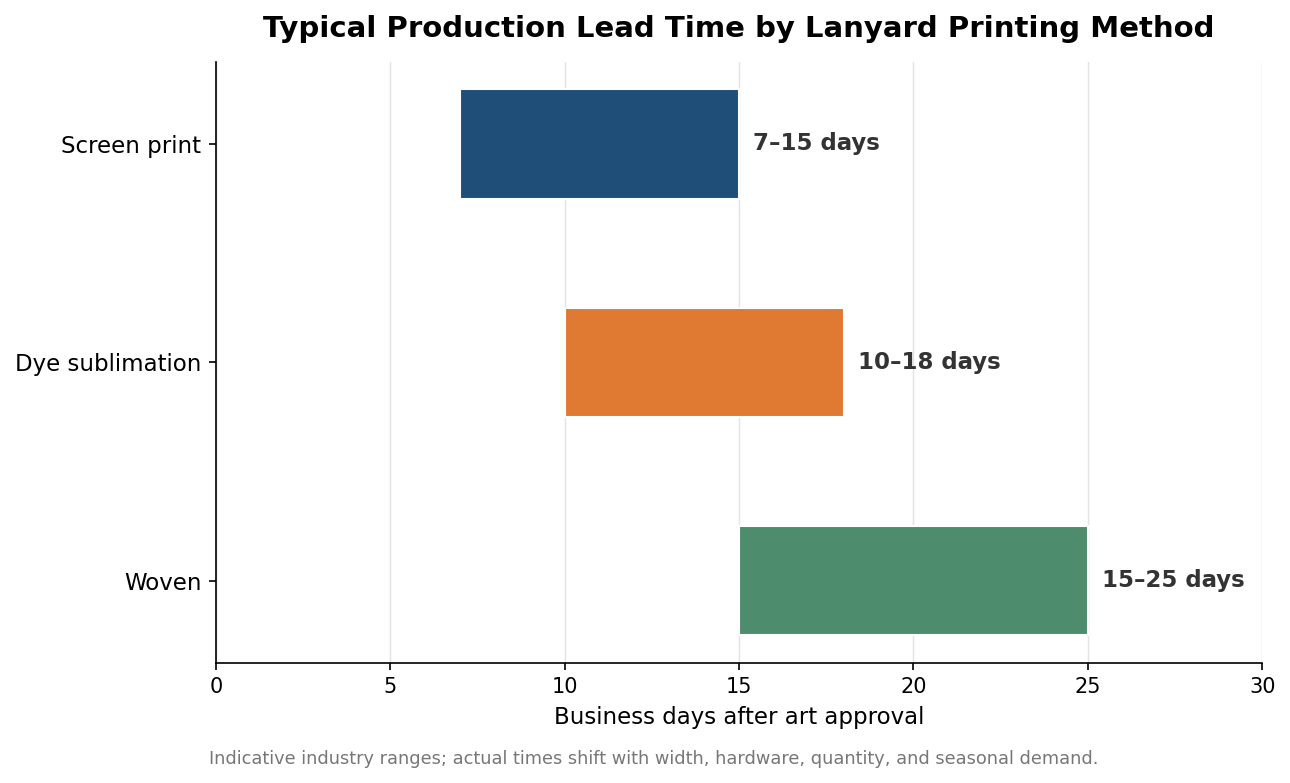
Practical logistics often decide the method as much as aesthetics do. Screen printing and dye sublimation tend to start at the lowest minimums—many shops open at 50 to 100 pieces—while woven usually carries a higher floor because the loom has to be set up for your specific design. Lead times climb in the same order: surface printing is fastest, sublimation is close behind, and woven takes longest because weaving is a slower build than printing.
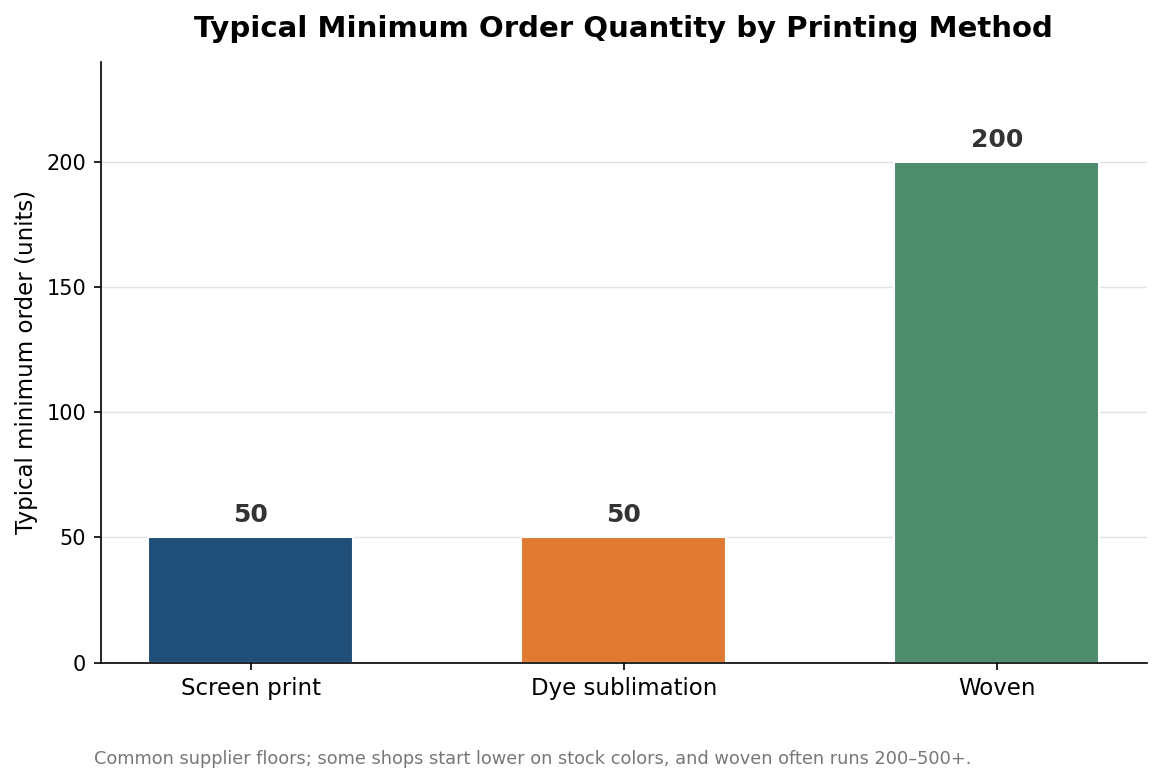
On unit cost, screen printing is typically cheapest at volume for simple art, dye sublimation is competitive and stays flat no matter how many colors you use, and woven commands a premium for its durability and finish. The ranges above are indicative industry figures rather than quotes; any real number shifts with your width, attachment hardware, one- or two-sided printing, packaging, and how busy the calendar is. Ordering into conference season or the back-to-school window will stretch every one of these timelines, so build in a buffer.
Match the method to the job rather than defaulting to the cheapest line item. For a corporate ID program or a school with a clean, one- or two-color logo and a tight budget, screen printing is the sensible workhorse: low cost, low minimum, quick turnaround. For a festival, tech expo, or any event where the strap itself is a branded canvas with multiple colors, gradients, or a repeating pattern, dye sublimation is the clear pick and the only one that reproduces full-color art faithfully. For a uniform program, an industrial setting where the band gets daily abuse, or a premium brand experience where feel matters, woven earns its higher cost and longer wait through durability and a tactile finish.
Whichever route you take, the printing method is only one layer of the spec. Attachment hardware, breakaway safety fittings, and eco materials such as recycled PET or bamboo are separate decisions you stack on top, and they carry their own tradeoffs. Before you approve a run, ask for a digital proof, confirm exact Pantone values for screen or woven work, and check the readable size of any small text at the actual strap width. Getting those details right up front is what separates a lanyard that looks sharp on every attendee from one you notice the flaws in only after the box arrives.