
Ordering event credentials looks like a single number, but “how many lanyards do we need” is the wrong question to start with. The right one is who gets a credential, in how many groups, with what buffer, and by when. Order too few and you are printing emergency badges at the registration desk on day one; order wildly too many and you have paid for and thrown away thousands of lanyards. This guide builds the number up in layers so the final order fits the event instead of a guess.
The method is the same whether you are running a 200-person conference or a 10,000-person expo: establish a base count, add a deliberate buffer, break it into credential tiers, remember the components beyond the lanyard, and back-plan the dates. Each layer has a rule of thumb, and each is a place orders commonly go wrong.
The base is the number of people who will actually wear a credential. For a pre-registered event that is your registration count on the order date, not the invite list. For an event with walk-up or on-site registration, the base is a forecast, usually built from last year’s final attendance or a percentage of venue capacity, because you cannot print to a number you do not yet have. A useful discipline is to separate confirmed from expected: confirmed registrations are firm, while expected walk-ups carry uncertainty that the buffer, not the base, should absorb. Anchoring the base to a real, dated number keeps the rest of the math honest.
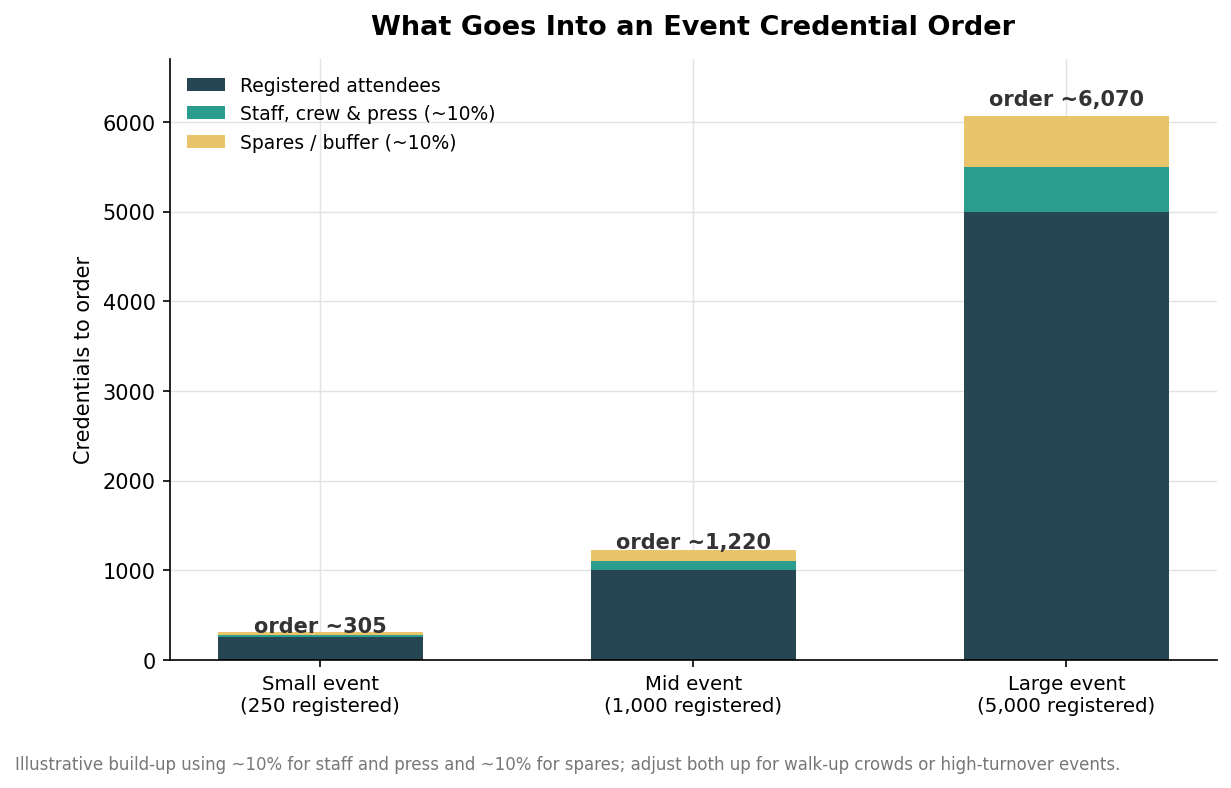
Every event needs spares, and the mistake is either forgetting them or padding blindly. A common working figure is about 10 percent over the expected count for replacements, damaged credentials, late additions, and the inevitable handful that walk off or get destroyed on day one. High-turnover or multi-day events, and anything with heavy walk-up, justify pushing the buffer toward 15 percent. The logic is asymmetric on purpose: for a fixed-date event, running out is expensive and visible, while a modest overage is cheap insurance, so the buffer leans slightly generous. What it should not do is balloon to 40 or 50 percent “just in case,” which is how boxes of unused lanyards end up in storage.
Attendees are only one population. A realistic event credentials plan usually spans several tiers: general attendees, staff and volunteers, exhibitors, press, VIPs or speakers, and sometimes contractors or security. Each tier is often visually distinct, by lanyard color, badge design, or an access marker, because the credential is doing double duty as an access-control signal. Two things follow. First, add the non-attendee tiers explicitly; staff and press alone commonly add another 8 to 12 percent on top of the attendee base, and they are the group most often left out of the count. Second, watch per-design minimums. Custom dye-sublimation lanyards frequently carry a minimum order per design, so a tiny VIP tier of 40 people may force you to round up to a minimum run or share a design across tiers to avoid paying for a nearly empty order.
A credential is rarely just a lanyard. A complete set is typically a lanyard plus a badge or printed insert, a holder, an attachment, and sometimes a reel. The quantities are not automatically identical. Lanyards and inserts usually match the total credential count one to one, but holders and reels are sometimes reused across events or issued only to certain tiers, so their quantities can be lower, planned to the populations that actually need them. Order the consumable items, the ones that go home with attendees, to the full buffered count, and order the durable, reusable items to the population that keeps them. Mapping each component to the right quantity avoids both the shortage of a missing insert and the waste of over-ordering reels nobody takes home.
It helps to run the layers as a quick worked example. Take a one-day conference with 1,000 confirmed registrations. Add staff, volunteers, and press at roughly 10 percent, or about 100 credentials, then a spares buffer at another 10 percent, about 120, for a working order near 1,220. Split that across tiers: say 1,120 attendee lanyards in the main color, 60 staff in a second color, 25 press, and 15 speaker or VIP, rounding the small tiers to any per-design minimums your supplier sets. Order lanyards and printed inserts to the full count, but only enough badge reels for the staff and speakers who actually need them. The number is now defensible line by line rather than a round guess, which also makes it easy to adjust if registrations move.
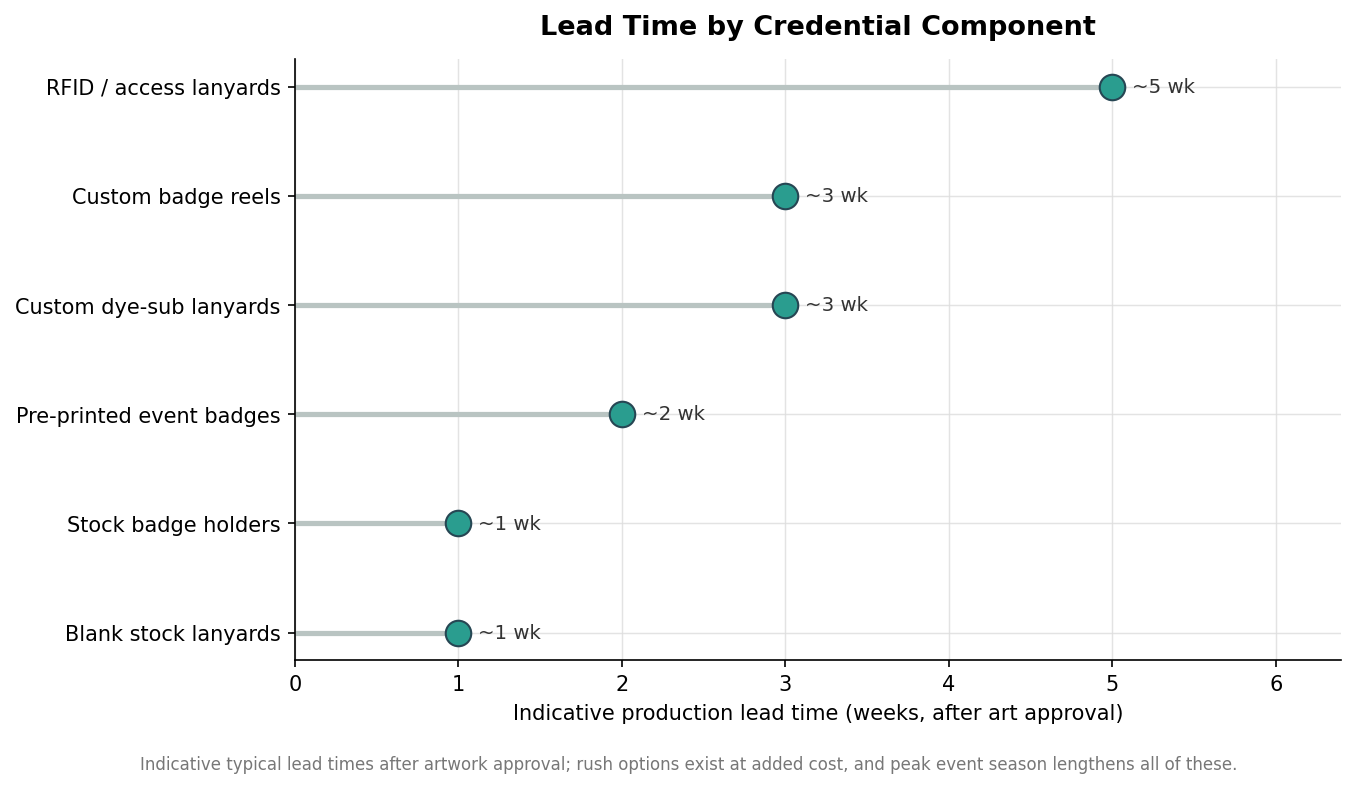
Quantity and timing are linked, because the buffer is partly there so you never have to place a rush reorder against a fixed event date. Production lead times vary widely by component: blank stock items can turn in about a week, pre-printed badges in roughly two, and custom dye-sublimation lanyards, custom reels, or RFID access credentials in several, with peak event season stretching all of them. Place the order early enough that the longest-lead component still lands with margin, and confirm art on that component first. If you do come up short despite the buffer, rush production exists, but it costs more and compresses your proofing window, so the planning goal is to make the reorder unnecessary rather than fast. Treat every lead time and percentage here as an indicative planning figure to confirm against your specific event, supplier, and season, not a fixed rule.