The custom lanyard material you choose decides how the print reads, how long the strap lasts, and how much your order costs per unit. Polyester, nylon, satin, tubular, woven jacquard and bamboo each carry distinct tradeoffs. This guide pulls them apart so you can spec the right fabric for badge holders, conference passes, brand giveaways or sustainability-forward gifts.
Most production runs land on one of six materials. Polyester is the volume default. Nylon is the durability default. Satin and tubular each have specific brand or budget uses. Woven jacquard is the high-end choice for premium brand events. Bamboo and other plant-fiber blends serve sustainability-led brands.
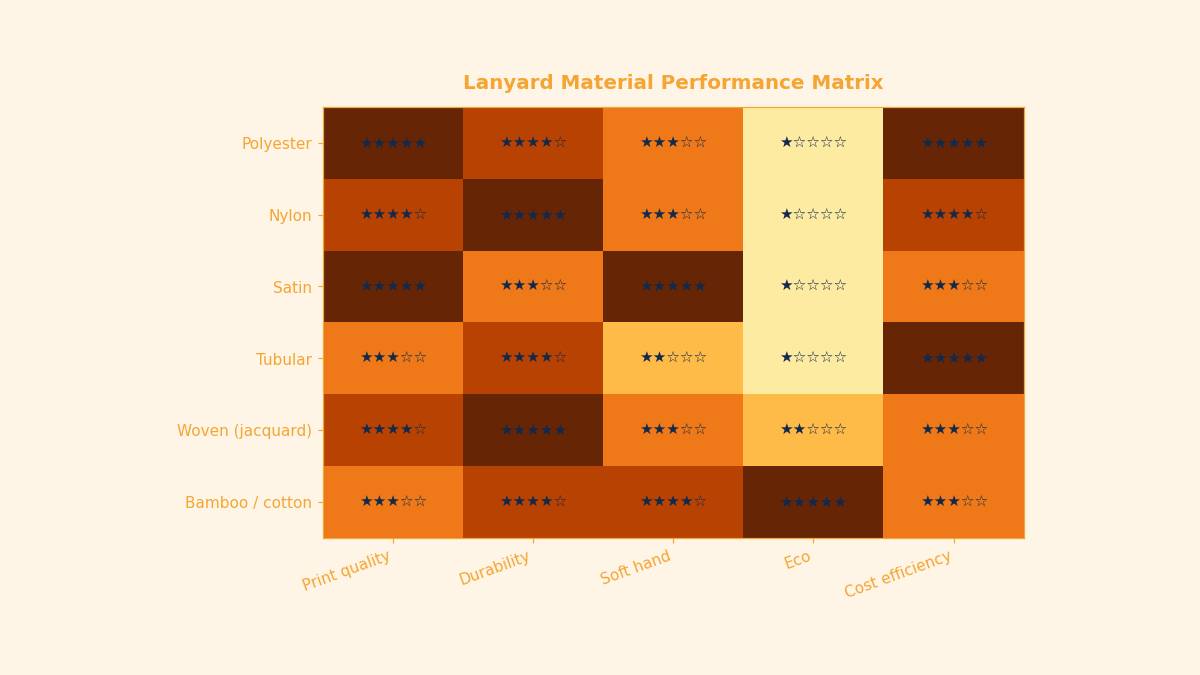
The matrix above scores each custom lanyard material across the five attributes most procurement teams care about: print quality, durability, soft hand feel, eco rating, and cost efficiency.
Polyester takes ink the best of any common lanyard fabric. Sublimation produces photo-real color and crisp small type. It’s also dimensionally stable, so the strap doesn’t stretch on the neck under normal use. The downside is environmental — polyester is petrochemical-derived and not biodegradable. For most corporate and conference runs, polyester remains the sensible default.
Nylon out-pulls polyester on breaking strength and abrasion resistance. The fabric also accepts dye-sublimation well, although the print typically has slightly less pop than polyester at the same DPI. Choose nylon for industrial uses, multi-year credentials, or anywhere a lanyard takes daily abuse.
Satin is the softest fabric on the neck, with a luxurious sheen that elevates the look of a premium event credential. The tradeoff is fragility — satin frays at the cut edges and has the lowest breaking strength of the six options here. Reserve it for higher-margin events where comfort and feel justify the upgrade.
Tubular polyester is the cheapest option per unit. The fabric is a single tube of woven poly, which means there are no cut edges to fray. It accepts limited print (usually one or two colors with screen printing) but absolutely wins on cost. Use it for one-day events, orientation runs, and any high-quantity giveaway where the lanyard’s job is to hold a badge for 24 hours.
Jacquard weaves the logo directly into the fabric. Detail is limited to roughly four colors, but the result has a tactile, premium feel that no print can replicate. Jacquard is the right choice for executive badges, retreats and recurring annual conferences where the lanyard itself becomes part of the brand.
Bamboo and recycled plant-fiber lanyards have moved from niche to mainstream over the last few years. They print at lower fidelity than polyester (think mid-range screen rather than photo-real sublimation) and cost roughly two to three times more per unit. For sustainability-forward brands and ESG-mandated procurement, bamboo lanyards earn the premium.
The chart above sets a 500-unit anchor for each custom lanyard material. Tubular polyester sits near $1.20, flat polyester near $1.45, nylon near $1.85, satin near $2.10, bamboo near $2.95, and woven jacquard near $3.40. Volume past 1,000 units flattens the spread between flat polyester and nylon, while bamboo and jacquard stay premium at any quantity.
Dye sublimation works best on polyester and nylon. Screen printing works on virtually any fabric but maxes out at three to four colors and small detail. Heat transfer fits printed lanyards that need photographic detail in a short run. Woven jacquard skips printing entirely — the design is woven into the strap.
Material is half the build; hardware is the other half. Bulldog clips and J-hooks remain the most common. Safety breakaways are increasingly required by hospitals, schools and corporate compliance teams. Confirm hardware spec at quote time so your custom lanyard material choice doesn’t get overshadowed by the wrong attachment.
Three quick questions narrow the choice. First, is this a one-day event or multi-year credential? One-day favors tubular polyester; multi-year favors nylon or jacquard. Second, does the brand require photographic color? If yes, sublimated polyester wins. Third, is sustainability a hard requirement? If yes, bamboo carries the right story even at a premium price.
Polyester is the volume default for custom lanyard material orders that need crisp print at a sensible price. Nylon wins where durability matters most. Bamboo and woven jacquard exist for brands willing to pay a premium for story or feel. Spec the fabric to the use case, lock the hardware at quote time, and your lanyard run will read clean from boardroom to badge desk.
Ready to design? Try our lanyard builder for instant quotes, see our in-stock lanyard options, or read the companion guide on badge holder sizing and card compatibility.
Enter below for a chance to win plus receive 10% off your first order.
Check your email for your 10% off code. Good luck!