
Every festival, conference, and corporate summit runs on a quiet system most attendees never think about: the badge around their neck. Well-designed event credentials do far more than print a name. They tell security who belongs where, keep talent and equipment areas clear of foot traffic, and let your team read access rights from across a crowded room in a single glance. Get the tiering right and the whole event flows; get it wrong and you spend the weekend refereeing arguments at rope lines.
This guide walks through how to design event credentials as an access-control system rather than a printing afterthought: how many tiers you actually need, how to make each one instantly legible, and how to choose the right credential format for the scale and risk of your event.
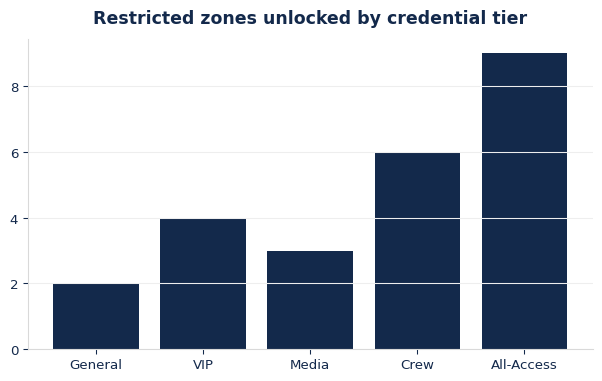
The most common mistake is designing badges first and figuring out access later. Flip the order. Walk your venue and list every space that needs a boundary: the main floor, VIP lounges, backstage or green rooms, production and crew areas, media pens, loading docks, and any secure storage. Each of those is a zone. Your tiers are simply the combinations of zones different groups are allowed to enter. Once the zone map exists, the credential design almost writes itself.
Most events over-tier. Three to five levels covers the vast majority of gatherings: general admission, an elevated guest or VIP level, working crew, and an all-access level for organizers and senior production. Media often gets its own tier because their access is wide but specific, cameras yes, dressing rooms no. Every extra tier you add multiplies the training burden on your gate staff, so add one only when a genuine access difference justifies it.
A credential only controls access if a tired volunteer can verify it in a second. That means big, unambiguous visual coding: a bold color band per tier, a large tier word or letter, and ideally an icon system so the meaning survives even in poor lighting. Reserve the back of the badge for the detail, zone list, schedule, emergency contacts, and put the access signal on the front where it does its real job.
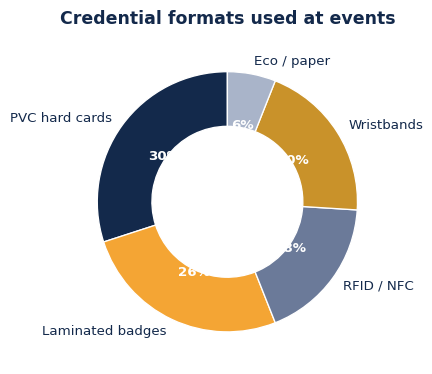
The physical format should match your event’s scale, duration, and risk. Laminated paper badges are cheap and fine for a one-day internal conference. PVC hard cards feel premium and survive multi-day festivals. RFID or NFC cards add real electronic access control and cashless payment for large or high-security events, at a higher cost per head. Wristbands are unbeatable for crowd-flow and re-entry but hold little information. Many events layer formats, an RFID card for staff and a color wristband for general admission.
| Tier | Typical holders | Access |
|---|---|---|
| General | Ticketed attendees | Public areas only |
| VIP / Guest | Sponsors, premium buyers | Public plus lounges |
| Media | Press, photographers | Floor, media pen, pit |
| Crew | Vendors, stagehands | Back-of-house, production |
| All-Access | Organizers, senior prod. | Every zone |
A handful of errors show up again and again. The first is granting all-access too freely, every extra all-access badge is another key to your most sensitive spaces, and they tend to multiply as favors during setup week. Keep that tier tiny and accountable. The second is inconsistent color logic across a multi-day event, where Friday’s crew color becomes Saturday’s VIP color and staff stop trusting the system. Lock the palette once and print it on reference cards. The third is designing for the opening rush but not the exit, re-entry, or the after-party, moments when access rules quietly change and an unprepared team improvises at the rope line.
Access is rarely static. A soundcheck zone opens to guests after doors; a VIP lounge closes during a private set; a media pen empties after the headline act. Decide these transitions in advance and give gate staff a simple written timeline rather than relying on radio calls in the moment. If your credentials are RFID, you can flip zone permissions centrally; if they are printed, a supplementary wristband or stamp handled at a single control point keeps the change orderly.
More events now pair a physical badge with a digital pass in an attendee’s phone wallet. The digital layer speeds check-in and lets you push schedule changes, while the physical credential remains the fast visual signal on the floor. For most events a hybrid approach is the sweet spot: keep the tangible, color-coded badge as the thing security actually reads, and use the digital pass for data, updates, and touchless entry where it genuinely helps. Going fully digital only works when every gate has reliable scanning and connectivity, which is a bigger ask than it sounds on a crowded festival field.
Higher tiers deserve harder-to-fake credentials. Sequential numbering, a photo for all-access holders, holographic overlays, and color-shifting ink all raise the bar against the classic problem of a crew badge quietly changing hands after load-in. For genuinely sensitive events, RFID lets you deactivate a lost or stolen credential instantly rather than hoping a visual check catches it.
People lose badges, and last-minute additions always appear. Print a small buffer per tier and keep a controlled reissue process so a replacement is not an accidental upgrade. A spare box of blank higher-tier stock, issued only with a manager sign-off, prevents the scramble that otherwise tempts staff to just wave someone through.
Your color system is worthless if staff have to memorize it cold. Print a small reference card, or the key on the back of every staff badge, showing which color equals which access. Brief the gate teams once before doors and the system runs itself. The goal is that any volunteer, on hour eight of a long shift, can look at a badge and know in one beat whether the person in front of them belongs.
Strong event credentials start from a zone map, use the fewest tiers that genuinely differ, and make access instantly readable through bold color and clear hierarchy. Match the format to your scale and risk, add anti-transfer features to the tiers that matter, and train your gate staff on the color logic. Do that and your credentials quietly run the whole event.
Tell us your tiers, quantities, and event dates and we will spec formats, colors, and security features that fit.
Get a QuoteHome · About · Buying guides · Companion guide: lanyard attachments
Enter below for a chance to win plus receive 10% off your first order.
Check your email for your 10% off code. Good luck!